Alleviate IT workload
Delegate remediation tasks to the site owners who actually have the business context, so cleanup stops being solely an IT problem.
IT owns the cleanup. It rarely owns the context.
Manual review cycles consume hours every week. IT ends up caught between over-blocking, which hurts productivity, and under-securing, which creates risk nobody can measure.
of IT leaders lack confidence in their ability to manage security and access risks in Microsoft 365
Gartner, 2025IT can see the risk, but can't close the gap alone.
Most organizations already have visibility. Purview, the SharePoint admin center, and access reports, all show where the exposure is. However, admin tools can't know if files shared by thousands of employees are still needed. Only the person who created the file knows that. Seeing the risk and fixing it are two very different things.
What IT has
Detection and visibility. Admin tools surface every risky share, sensitive file, and stale permission across the tenant.
The gap
Detection is not remediation. IT cannot decide, file by file, what is still needed, and lacks the tools to inform site owners at scale or remediate effectively. So reviews stay episodic, and the backlog grows.
What closes it
Business context. The people who created a share, or who own a Teams or SharePoint site, know if access is still needed and what should happen to that content. WeActis routes the fix to them, inside Teams, so detection finally turns into resolution.

Close the gap by putting remediation in the hands of the data owner.
Give the decision back to the people who have context.
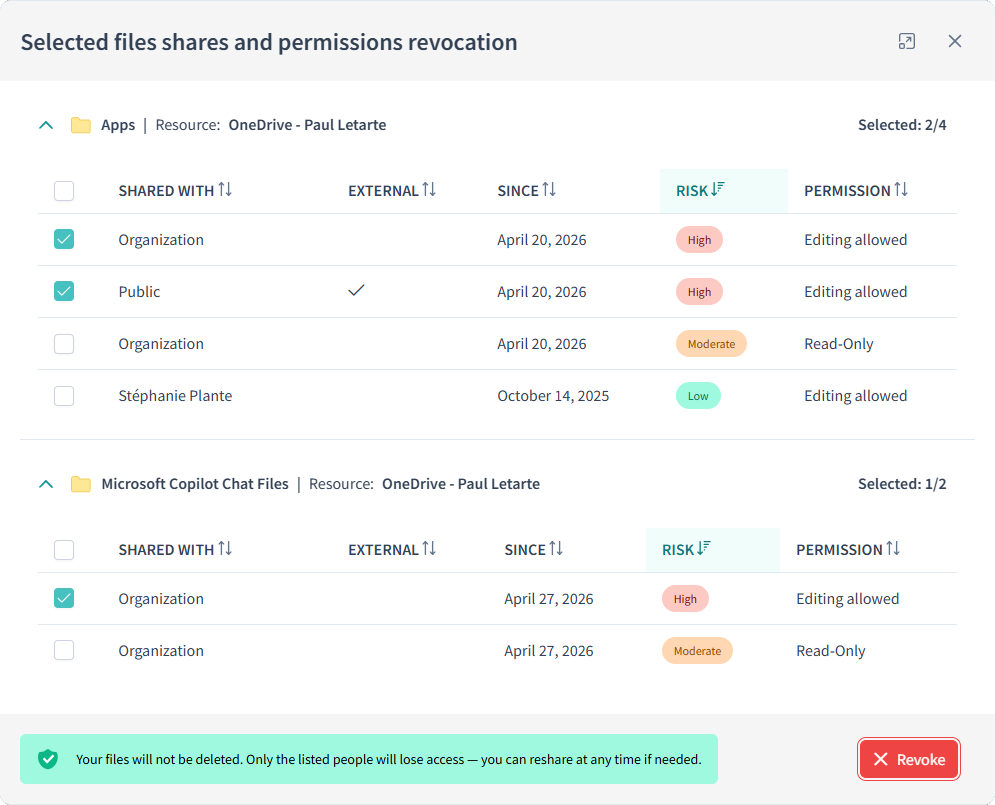
Remediation tasks, revoke, justify, apply a security model, archive a Teams or SharePoint site, are delegated directly to resource owners, with a configurable notification cadence, daily, weekly, or monthly.
Approval workflows that do not sit in a queue.
Creating a new Teams or SharePoint site routes through a lightweight approval flow instead of an open-ended IT ticket, so nothing waits on a backlog IT cannot handle.
The clearest content gap, made concrete
At Biron Health Group, distributing cleanup responsibility across the organization produced a lower volume of IT requests related to permissions review or file cleanup, and less time spent by managers validating access.
Delegate the work to the right people
Revoke, justify and reviews handled by resource owners, not IT.

Quick deployment and excellent experience with agile feature support
Director of ITGovernment
Questions we hear a lot
How does WeActis reduce IT workload in Microsoft 365?
WeActis delegates the actual remediation work (revoking or extending a share, justifying continued access, applying a Security Model, archiving a Teams or SharePoint site when it's no longer needed) to the employees and Teams or SharePoint site owners who actually have the business context.
Does IT keep oversight and control when using WeActis?
Yes. IT defines the guardrails, cadence, and role-based delegation rules inside WeActis. Owners complete remediation tasks within those guardrails, and administrators retain full visibility through the WeActis dashboard including completion rates, outstanding items, and risk trends.
What notification cadence can we set for WeActis?
Daily, weekly, bi-weekly, or monthly, whichever fits your organization's culture and risk tolerance. WeActis only notifies users who have outstanding items, so no one receives unnecessary messages.
Which tasks can be delegated to end users?
Revoking a share, justifying continued access, applying a security model, and archiving a Teams or SharePoint site when it's no longer needed. IT sets the policy and cadence, employees and Teams and SharePoint site owners carry out the work from inside Microsoft Teams.
What is the Data Security Operational Gap, and how does WeActis close it?
The Data Security Operational Gap is the distance between what detection tools identify as risky and what IT can actually fix manually. Security tools surface thousands of findings; IT teams cannot act on all of them. WeActis closes the gap by distributing the remediation work to the people closest to the data.
How does WeActis governance delegation differ from Microsoft Entra identity governance?
Entra Identity Governance manages structured identity data: access reviews for app roles and group memberships. WeActis manages the unstructured content layer: Teams sites, SharePoint sites, shares, and files, the day-to-day collaboration data that lives outside the scope of traditional identity governance.
See what else WeActis can do
- Reduce oversharing
- Adopt AI safely
- Alleviate IT workload
- Cut SharePoint costs
- Skip DLP delays
Try it for yourself.
See how easy it is for a data owner to take action inside Microsoft Teams, no new platform to learn.