Cut SharePoint storage costs
Let the people who created the content decide what moves to cold storage, and cut the bill without breaking anything still in use.

For a decade, two teams have argued about the same data.
IT watches the storage bill climb every quarter, knowing most of it is paid for content nobody uses or even remembers. Legal and compliance need that same content kept, just in case someone asks for it years later. Both are right. And while they argue, the bill keeps growing.
Then IT was handed a harder question: what to archive?
Microsoft 365 Archive put a cold storage tier directly in SharePoint. Archived sites stay in the tenant, remain searchable, stay in scope for eDiscovery and Purview retention, and cost about a quarter of active storage ($0.05/GB vs. $0.20/GB). Compliance keeps every byte, IT pays far less. The economics are solved. What no admin console can answer is which sites should actually move, and the default last-activity report is wrong in both directions.
Inactive is not inert
A master service agreement untouched for three years can still define the indemnity terms on a contract that runs until 2031. A last-activity report would archive it anyway.
Active is not valuable
A site hammered with traffic every day can be full of duplicated drafts, expired pricing, and personal scratch files that should never have existed.
Only the owner knows
The contract manager, the R&D engineer, the project lead know what is still the source of truth. None of them will ever open the SharePoint admin center.

Bring the data owner into the archiving decision.
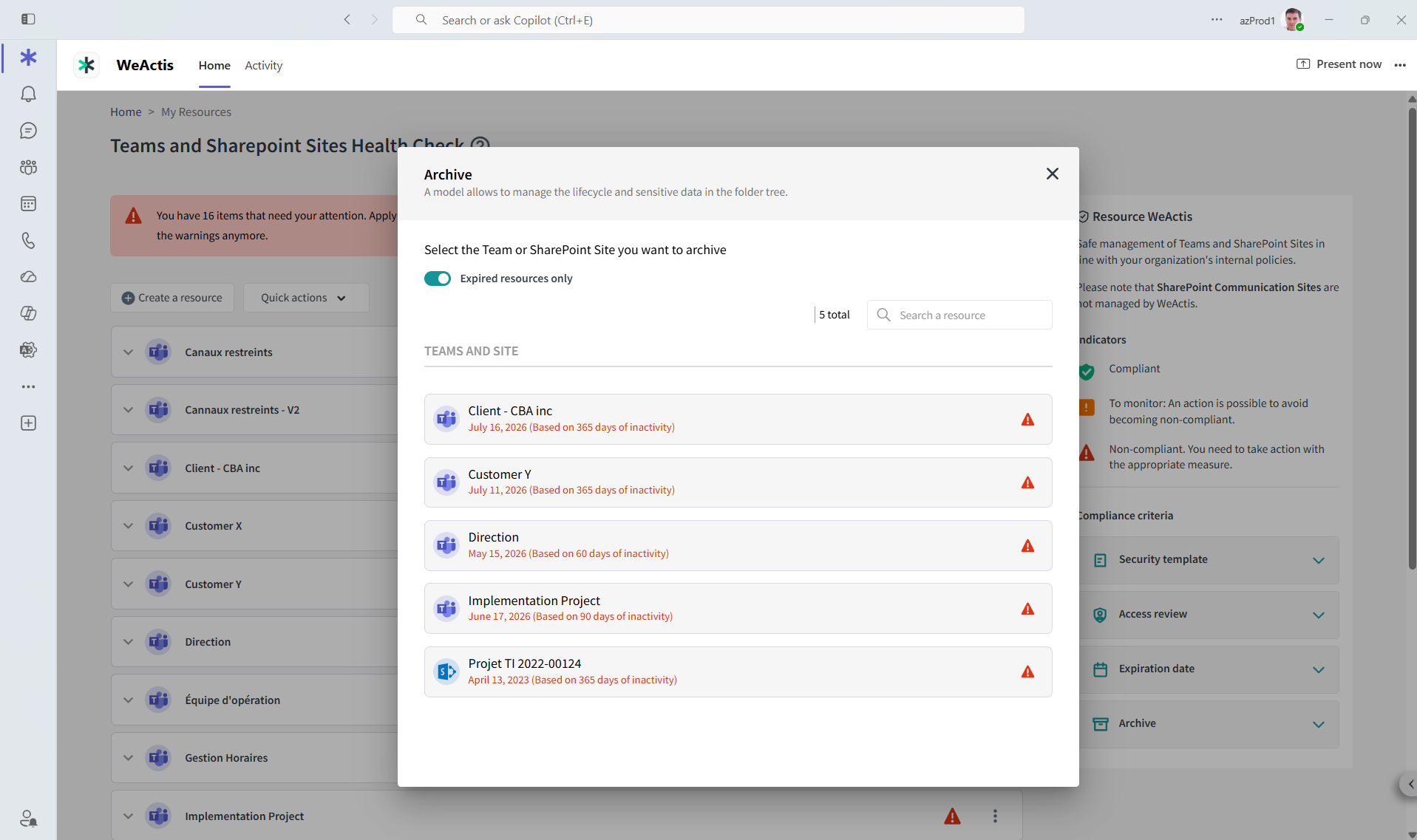
WeActis is a Microsoft Teams app that surfaces the data each employee actually owns and asks the only question that matters: is this still business-relevant, or can it move to archive? The data owner can flag, in a couple of clicks, which sites can be archived, since they have the business context around what content is still needed.

The owner decides, in Teams
The only person who knows whether a site is still the source of truth confirms what stays live and what moves to cold storage.
IT gets a defensible record
Every archive decision is tied to a named human and a timestamp, so the storage curve finally bends and the choice is auditable.
Compliance gets evidence
Retention becomes a continuous operating process, not a policy document, with archived content still in scope for eDiscovery and Purview.
Owners decide what moves to cold storage
Business relevance, not a bulk IT policy.

Great solution for file share security management on M365
VP, ITFinance
Questions we hear a lot
How does WeActis reduce SharePoint storage costs?
WeActis integrates with Microsoft 365 Archive and lets Teams and SharePoint site owners move those they no longer need to cold storage at $0.05/GB/month instead of $0.20/GB/month for active storage. The decision stays with the person who knows whether the content is still in use.
Why not just archive dormant SharePoint sites automatically?
Inactivity is not a reliable signal. A quiet site can still be the authoritative source for a contract, a legal case, or a key project, something no automated rule can detect. WeActis routes the archiving decision to the owner, so nothing that is still actively needed is moved to cold storage.
Who decides what gets archived with WeActis?
The people who created the content, not IT. WeActis prompts resource owners inside Microsoft Teams when a site is approaching its expiration date, giving them the context and the tools to archive it or extend its lifecycle.
How large can the storage savings be with WeActis?
Significant and recurring. A 50 TB overage at $0.20/GB costs roughly $120,000/year in active storage. Archived at $0.05/GB, the same data costs $30,000/year: a $90,000 annual reduction. WeActis surfaces the opportunity; owners execute it.
What is the difference between active and archived storage pricing in Microsoft 365?
Active SharePoint storage costs approximately $0.20/GB/month for usage beyond your included tenant storage. Microsoft 365 Archive cold storage costs $0.05/GB/month: a 75% reduction. Archived content remains searchable and can be reactivated if needed.
Does WeActis use Microsoft 365 Archive, or does it have its own cold storage?
WeActis integrates directly with Microsoft 365 Archive, Microsoft's native cold storage tier for SharePoint. WeActis handles the owner engagement and workflow, M365 Archive provides the storage infrastructure. Where M365 Archive is not yet configured, WeActis can remove access immediately and queue the item for admin review.
See what else WeActis can do
- Reduce oversharing
- Adopt AI safely
- Alleviate IT workload
- Cut SharePoint costs
- Skip DLP delays
Try it for yourself.
See how easy it is for a data owner to take action inside Microsoft Teams, no new platform to learn.